
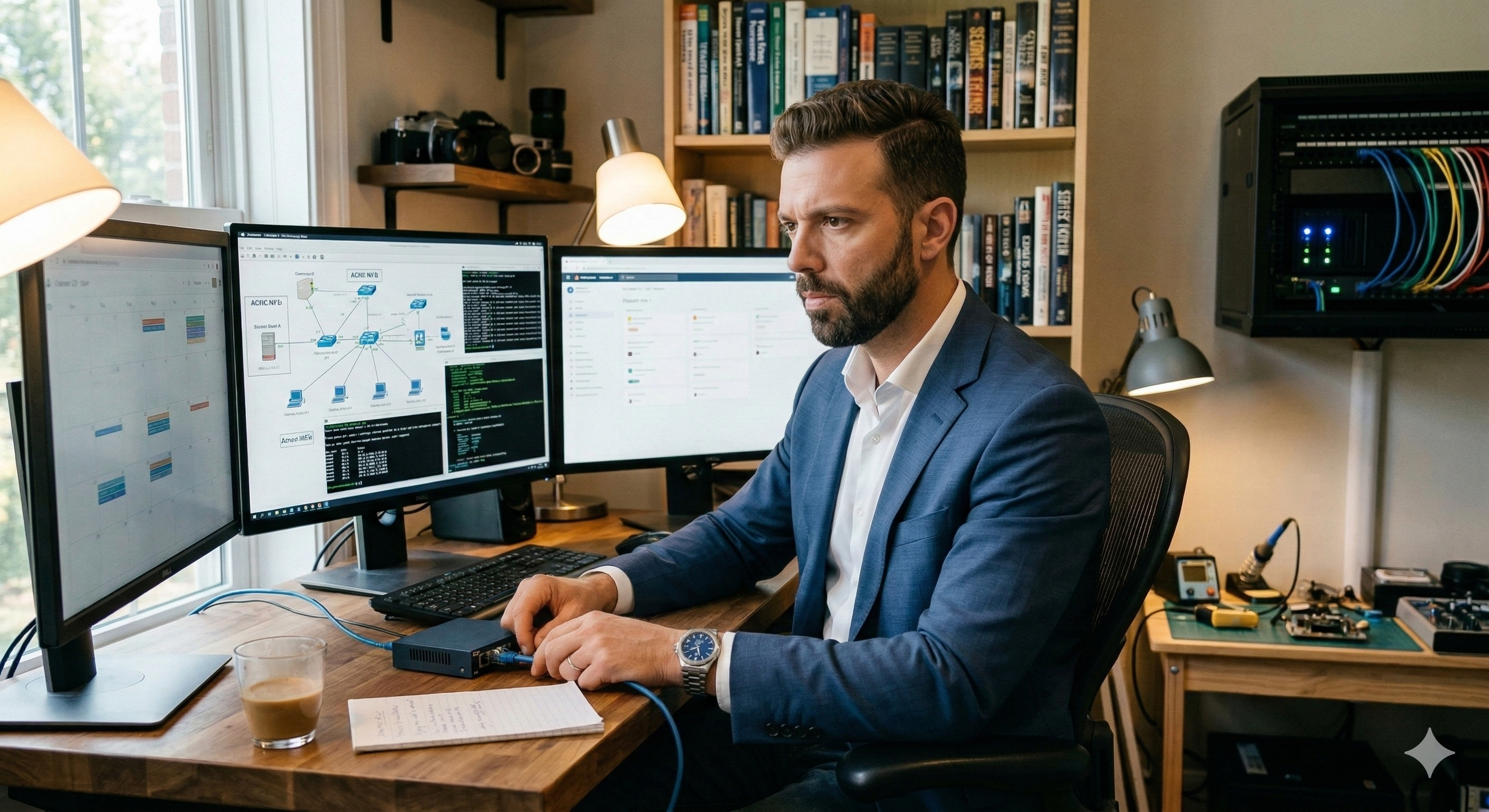
When your network goes down on a Friday afternoon, you have two options. You can call a corporate IT help desk and get a ticket number, a callback window, and eventually a Tier 1 technician reading from a script. Or you can call your IT partner — the person who built your environment — and get answers.
That’s the core of the solopreneur advantage. It’s not a marketing tagline. It’s a structural difference in how support gets delivered, and it matters more than most businesses realize until something goes wrong.
Zero Learning Curve
Every support engagement with a large MSP or call center begins the same way: with explanation. Who are you? What system? What version? What changed last? The technician picking up your ticket has never seen your environment before and has no obligation to remember it after the call ends.
When you work with a 1-person MSP, that dynamic flips entirely. Your IT consultant built your stack. They configured your firewall rules, set up your Microsoft 365 tenant, onboarded your users, and documented every decision along the way. When something breaks, there’s no briefing required. Diagnosis starts immediately — not after a 15-minute intake process.
Accountability That Goes All the Way to the Top
At a corporate help desk, accountability is diffuse. If your issue gets dropped, escalated poorly, or resolved incorrectly, the feedback loop is long and often meaningless. No single person owns your outcome.
With a solopreneur MSP, you’re always talking to the owner. There’s no intern, no Tier 1, no “let me transfer you.” The person who answers is the person responsible — financially, professionally, and reputationally. That changes everything about how a problem gets treated.
Agility a Corporate Desk Can’t Match
Large IT organizations move through layers of process. Change requests, approval queues, escalation matrices. These structures exist for good reasons in enterprise environments — but they’re a liability when a small business needs something resolved now.
A solopreneur MSP can pivot immediately. There’s no committee to convene. The decision is made and the fix is implemented — often before a corporate help desk has finished assigning the ticket to the right queue.
Specialized Care, Not Standardized Support
Corporate MSPs optimize for volume. Their processes, tooling, and staffing models are designed to handle the largest number of tickets with the fewest specialized decisions. That works for commoditized problems. It fails for businesses with nuanced environments, compliance requirements, or workflows that don’t fit a standard template.
Small businesses — especially law firms, professional services firms, and organizations handling sensitive data — don’t need standardized support. They need a technician who understands their business, not just their hardware. A solopreneur MSP builds that understanding over time and applies it to every interaction.
The Real Cost of a Ticket Number
Downtime costs money. Every hour a user can’t access their files, email, or line-of-business software has a dollar figure attached to it. When support is slow, that cost compounds. When support requires repeated callbacks, escalations, and re-explanations, it compounds further.
The solopreneur model is built around eliminating that friction. Fast response, deep familiarity, and direct ownership translate into shorter resolution times — and shorter resolution times translate directly into lower real costs, even when the monthly retainer appears higher than a per-incident call center rate.
Is a 1-Person MSP Right for Your Business?
The solopreneur model isn’t for everyone. Enterprises with hundreds of endpoints and complex multi-site infrastructure need a scaled team. But for small businesses — 10 to 75 users, professional services environments, organizations that value relationship over volume — a dedicated, experienced solo MSP isn’t a compromise. It’s the better choice.
If you’re currently relying on a reactive break-fix model or a call center that doesn’t know your name, it may be worth a conversation about what a different model looks like.